

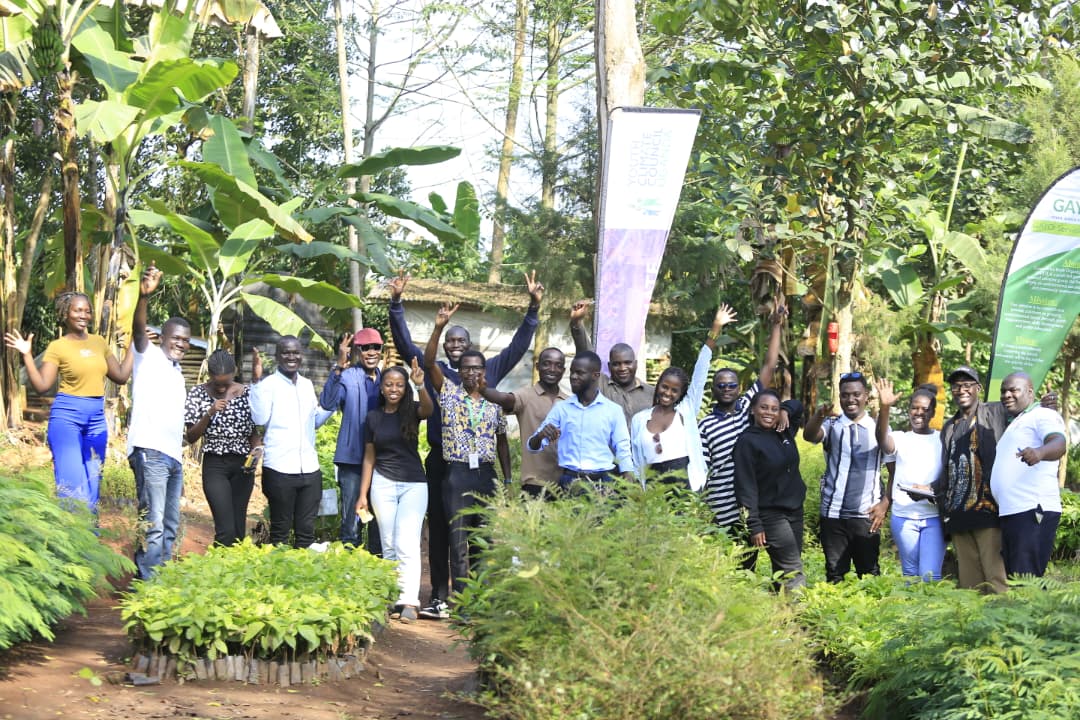
More than 200 young people have gained practical knowledge in sustainable farming following a circular regenerative agriculture mentorship training organized by the Green Africa Youth Organization (GAYO) in partnership with Farm Radio International, the Youth Climate Council Uganda, and Trinity Forestry Services.
The program, which began on 9 March with four days of virtual sessions, concluded on Saturday, 14 March, with hands-on field training at Trinity Forestry Services’ farm in Nganjo Village, Luweero District.
According to the organizers, the mentorship aimed to equip young people with skills in circular regenerative agriculture, sustainable agribusiness, and agricultural communication.
Jemimah Babirye Kasibbo, programs lead at GAYO, said the initiative seeks to promote environmentally friendly farming practices while creating livelihood opportunities for youths.
“Circular regenerative agriculture is a form of farming that restores the environment. It is different from conventional agriculture, where trees are often cleared for subsistence crops,” Kasibbo explained.
She added that the training was designed to provide practical knowledge in both sustainable agriculture and agribusiness.
“This week, we conducted five days of training covering circular regenerative agriculture, market chains and values, sustainable agribusiness ventures, and communication in agriculture. By the end of this program, we hope to have developed a group of youths capable of producing food sustainably while protecting our environment,” she said.
Kasibbo noted that a major challenge is the perception many young people have about agriculture.
“There is a bias among youths toward agriculture. Many see it as dirty work meant for the poor. Yet, in today’s economy, it is crucial to explore sustainable livelihood alternatives,” she added.
The mentorship also focused on bridging gaps between policymakers, farmers, and young people, while emphasizing the importance of communication in agriculture to promote agribusiness opportunities.
Christopher Marvin Tumusiime, founder and acting CEO of Trinity Forestry Services, said the program equips youths with sustainable farming practices and addresses the challenges they face.
“Many young people lack land, capital, and practical knowledge about farming. Financial institutions often hesitate to support them at the start,” Tumusiime said.
The training introduced participants to practical methods such as agroforestry, soil and water conservation techniques, and integrated farm management.
“We taught practices like combining crops, trees, and livestock on the same land, soil and water conservation techniques including contour bands, fanya juu and fanya chini, planting grasses, and managing livestock and poultry,” he explained.
Tumusime also encouraged young people to view agriculture as a business and leverage digital platforms to promote farming activities.
“Youths should integrate agriculture, forestry, poultry, and livestock into digital content creation to raise awareness and inspire others,” he said.
Participants praised the mentorship, highlighting its practical and educational value.
Leticia Ahirirwe, an agriculture scientist and co-founder of the Food and Agribusiness Management Association of Uganda, noted the importance of indigenous knowledge in farming.
“One key takeaway is the use of indigenous farming knowledge. Many young farmers overlook this and rely solely on modern techniques, which sometimes exploit the land and ecosystem,” she said.
Ahirirwe encouraged youths to maximize the land they already have, emphasizing that even small plots can yield meaningful projects.
Francis Alemiga, a trainee from the Youth Social Economic Development Consortium (YESDEC), commended GAYO for providing an opportunity for young people across Uganda to interact with experts and gain practical skills.
“The hands-on training was particularly impactful. We acquired valuable knowledge and practical skills that we can apply in our communities,” Alemiga said, pledging to implement what he learned in the West Nile region and encourage peers to adopt sustainable agricultural practices.
Organizers said the mentorship program is part of broader efforts to increase youth participation in sustainable agriculture while promoting climate resilience and environmental conservation in Uganda.
